
Cheltenham Township City Directory Collections
Verified Cheltenham Township historical sources do not form one complete city-directory shelf. Instead, a strong Cheltenham Township search combines the few confirmed directory-related items with county and state collections that establish a person, place, or household at a particular time. The most specific digitized directory item is a Library of Congress Philadelphia white-pages segment from August 1964. Its locality index includes Cheltenham and Elkins Park, but the scanned segment runs only from LAZAROF through Z. It is a real image-based lead for surnames in that portion, not evidence of a complete Cheltenham Township run or an address-ordered directory.
| Collection | Years | Where held | Access |
|---|---|---|---|
| Library of Congress Philadelphia white pages, LAZAROF through Z | August 1964 | Library of Congress digital collection | Online image segment; locality index includes Cheltenham and Elkins Park |
| PHMC Cheltenham Township tax lists | 1785-1789, 1791-1801, 1803-1822, 1824-1834, 1834-1835 | PHMC digitized county-records guide | Online guide; inspect the original item for fields |
| PHMC Montgomery County census manuscript | 1880 | PHMC online collection | Online entry with a Cheltenham Township link |
| Federal population schedules | 1790-1950 public schedules | National Archives | Public historical source; most 1890 material was lost |
| County archival and microfilm routes | Historical material; date varies by record group | Montgomery County Archives and FamilySearch microfilm route | Walk-in, inquiry, or public microfilm access |
A confirmed catalog run for Cheltenham Township city directories, reverse directories, yearbooks, or local obituary indexes was not found during the research. The Cheltenham Township Library System is still a valid inquiry route, but ask staff to check the catalog and local-history storage before saying a particular title or year is held. A careful Cheltenham Township city directory search identifies the exact volume, publisher, year, page, and whether it is a directory, tax list, census, or telephone book.
Cheltenham Township Directory Place Names
Cheltenham Township directory research changes when the same place appears under several names. Search catalogs and finding aids for Cheltenham Township along with Elkins Park, Wyncote, Glenside, La Mott, Cheltenham Village, and Shoemakertown. The Township history connects Shoemakertown to the Shoemaker mill and says it is now part of Elkins Park. Wyncote developed in the late 1880s, while La Mott has distinct historic-district context. A missing result under one current label is therefore not enough to rule out a relevant Cheltenham Township source.
The printed locality is evidence in its own right. Do not silently convert an Elkins Park telephone-book entry into a Cheltenham Township address, or apply a modern ZIP label to an early tax list. Keep the street, township, post-office wording, nearby community, and original date in the Cheltenham Township research notes. These details also make it easier to use the Township history, Recorder plans, county tax maps, and historic-district material to resolve a changed street or block number.
PHMC's 1880 Montgomery County census-manuscript collection provides a confirmed Cheltenham Township historical entry point.
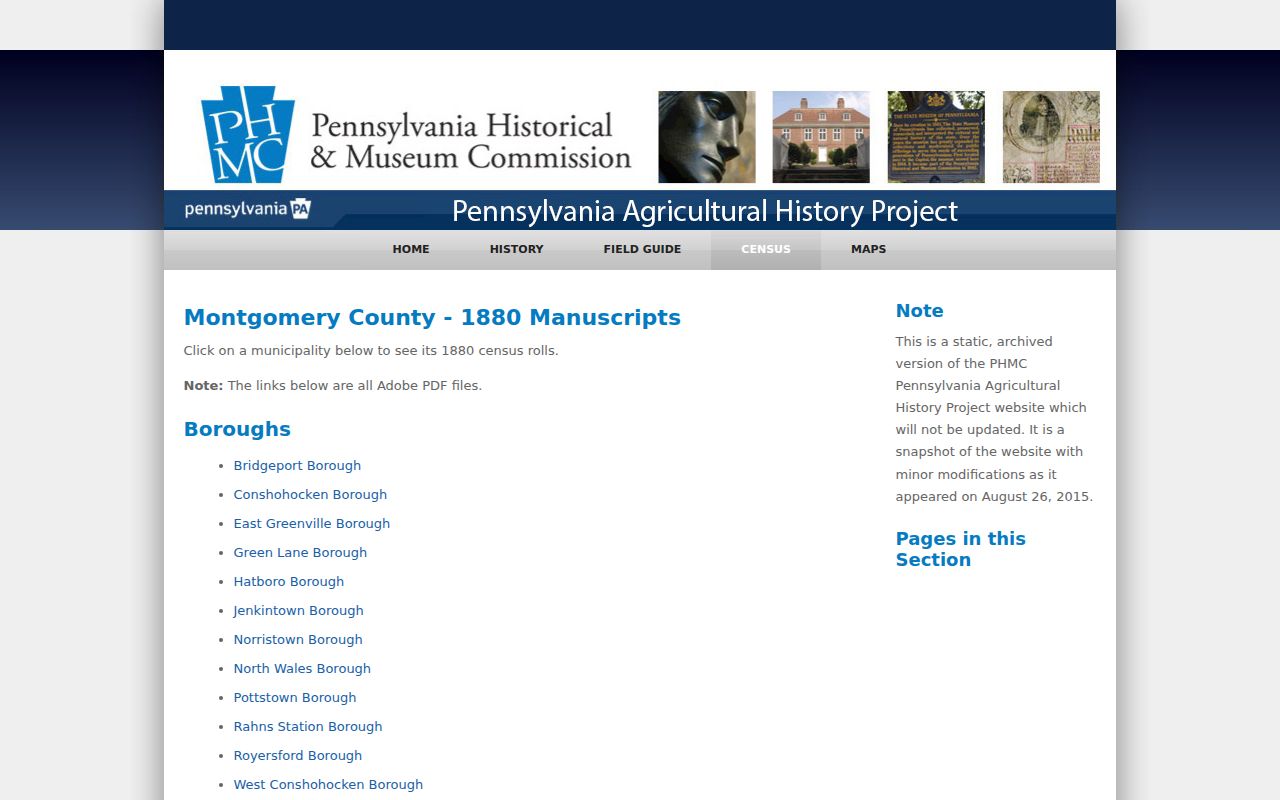
The collection supports a dated township enumeration search and should be paired with the original manuscript fields, not treated as a modern street-address directory.
Reading Cheltenham Township City Directories
No actual Cheltenham Township city directory entry was available in an official open interface during the research, so a local sample should not be invented. A printed Cheltenham Township directory entry is a publisher's shorthand record, not a government filing. When a verified volume is located, transcribe every element that is actually printed. A street and number can be a lead for that publication date. A township or post-office label needs a census, tax, land, probate, or other dated source before it is connected to one Cheltenham Township parcel.
| Name spelling | Copy the printed spelling, initials, and punctuation. Do not normalize it before checking another source. |
|---|---|
| Relationship or role shorthand | Transcribe any printed notation exactly, then photograph or cite the abbreviation key if the volume provides one. |
| Street, number, or locality | Keep the address, township, ward, or post-office wording as printed and record the publication year. |
| Volume citation | Record the title, publisher if stated, year, page or image, and whether the item is a directory or telephone-book segment. |
| Corroborating record | Pair the listing with a nearby census, tax, deed, probate, or archival record before making a stronger conclusion. |
- Criss-cross directory
- A separately dated street-ordered section, if a verified local volume contains one. It should never be presumed to cover every household.
- Householder index
- An index organized around the household or address headings used by a specific publication. Confirm its coverage and date from that volume.
- Abbreviation key
- The publisher's explanation of its shorthand. Capture it with the entry because the meaning can vary between titles.
Follow a Cheltenham City Directory Trail
A Cheltenham Township family-history search benefits from a record trail that moves forward one dated item at a time. The result may be a city directory entry, a tax-list appearance, a census household, a probate record, or a deed reference. The strongest conclusion comes from compatible details across at least two sources, not from a name alone. The 1890 federal census was largely destroyed, so the 1880-to-1900 interval should be treated as a genuine gap rather than filled with inference.
- Search the place variants and identify the exact historical item, date, title, and page or image.
- Transcribe the name, printed locality, street information, and any notation without changing the source wording.
- Check a nearby item, such as the 1880 manuscript, a federal census schedule, a Cheltenham tax list, a probate record, or a recorded document.
- Log moves, spelling changes, and community labels by date. A change in wording may reflect the source, not necessarily a move.
- Use the County Archives, Register genealogy guidance, or a library inquiry when the online path stops, and retain the response or counter citation.
A name disappearing from one publication can mean a move, a changed label, a scope gap, or an editorial choice. It is not proof of death, ownership, or a relationship. For the modern address-to-parcel path after a historical lead is verified, use the Cheltenham Township street directory record chain.
Cheltenham Township Tax List Bridge
PHMC's digitized county-records guide gives Cheltenham Township a deeper source ladder than the known telephone directory segment. The guide identifies tax-list groups for 1785-1789, 1791-1801, 1803-1822, 1824-1834, and 1834-1835. These groups are especially useful across the 1784 shift from Philadelphia County to Montgomery County. They can establish a taxable name or Cheltenham Township presence before reliable modern street numbering, but they are not deeds and may not contain street numbers.
This Cheltenham Township local history feature has a practical payoff. The township's records need to be read in eras: early tax and land context, then census and county records, then later phone or directory material, then current parcel systems. The Wall House and Tookany Creek history provide local context for Cheltenham Township place terms, but a historical story should remain separate from evidence about a particular household.
Note: Preserve the source's own township and community wording because it can be the key to locating the next record.
Cheltenham Township Directory Records Timeline
Cheltenham Township's record systems reflect a long suburbanizing township history rather than a single municipal archive. The Township says the area was founded in 1682 while part of Philadelphia County, and it became part of Montgomery County on September 10, 1784. That transition helps explain why the county Recorder, Register, Archives, and tax-list sources are central to Cheltenham Township research, while earlier references can need Philadelphia-era or local historical context. The chronology also helps prevent a current portal from being mistaken for the original source of a historic record.
- 1682: Township history dates the original portion of the Wall House to this period.
- 1784: Montgomery County formation creates the later county institutional frame for Recorder, Register, Archives, and tax-list records.
- Late 1880s to 1915: Wyncote's development and street grid create a later development-era context for plans and directories.
- 1964: The Library of Congress digitized white-pages segment includes Cheltenham and Elkins Park in its locality index.
- 2025: Cheltenham moved permit and zoning applications into OpenGov, a later electronic layer that does not replace older custody paths.
Cheltenham Township Archives and Libraries
Historical Cheltenham Township city directory work continues beyond the web. Montgomery County Archives at 86 Eagleville Road welcomes walk-ins, has pre-1906 birth and death material, archived record groups, and microfilm leads, but it does not certify records. The Register of Wills genealogy guidance says early county land, probate, birth, death, and marriage records were microfilmed and are available to the public through FamilySearch. The Cheltenham Township Library System has branches in Elkins Park, Glenside, East Cheltenham at Rowland Community Center, and La Mott at La Mott Community Center. Its locations page is the direct route for an informed Cheltenham Township catalog or storage inquiry.
The Cheltenham Township Library System locations page identifies the four community branches available for a historical-collection inquiry.
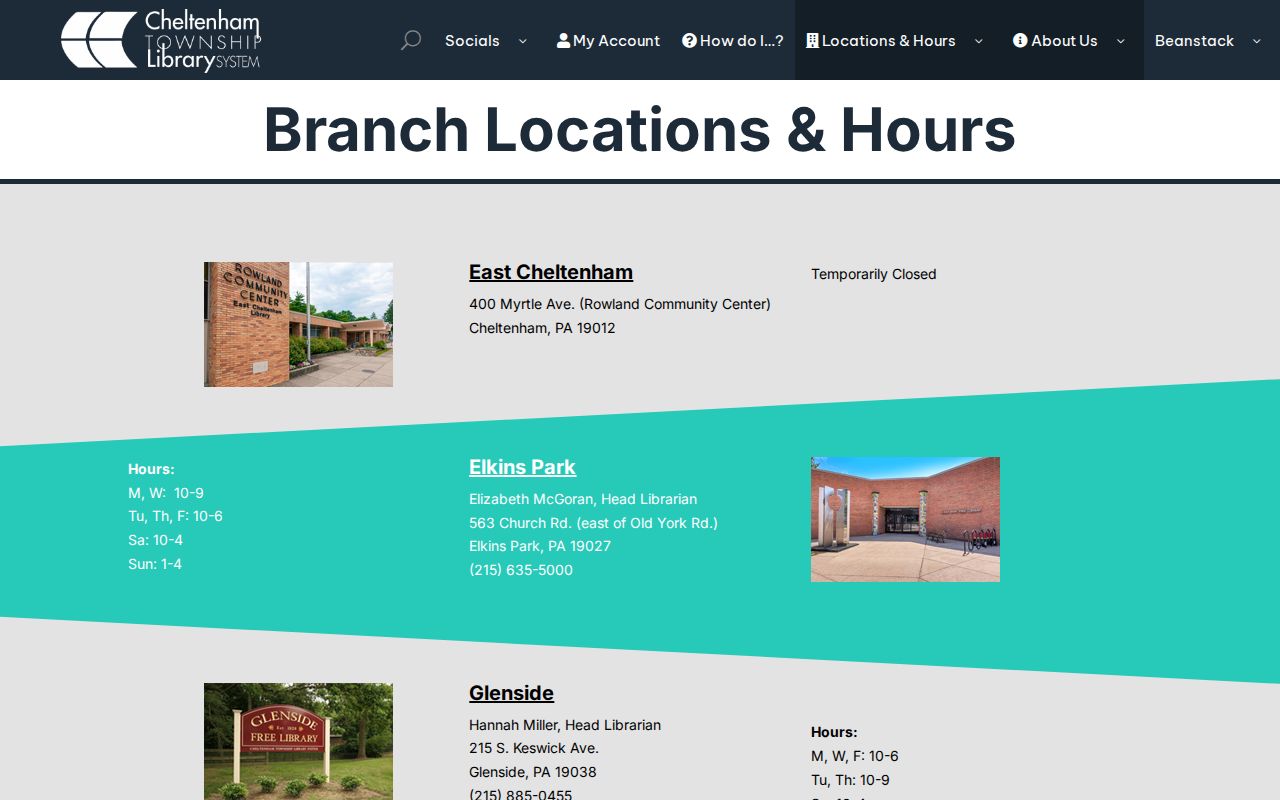
The branch page confirms service locations, not a particular city-directory or yearbook run, so ask staff to verify a specific title, year, access condition, and storage location.
PHMC and the National Archives add online routes. National Archives census guidance explains the public federal schedules through 1950, while the County Archives retrieval page identifies its historical request channels. In March 2026, the Prothonotary reported that partner county libraries could offer access to most unsealed civil filings through Civil Viewer; confirm a participating library and the rule on the day of any visit.
Cheltenham City Directory Source Boundaries
Every Cheltenham Township historical source has a scope. A Library of Congress white-pages segment is not a comprehensive Cheltenham Township city directory or a reverse directory. A tax list is not a deed. A census household is not a parcel boundary. A microfilm mention does not establish the fields or years in a reel until that item is inspected. This distinction is especially important where Cheltenham Township historical place names overlap with modern postal labels or where a street changed its presentation over time.
Use source date, source type, exact wording, and a second compatible record to keep the trail reliable. The Township Historical Commission, Wall House materials, and the twice-yearly Wall Paper publication can supply local-history citations and preservation context. They are useful leads for checking original dates and places, not a substitute for a complete directory sequence. The historical shelf has real gaps, and stating them is more accurate than inventing a tidy all-years run.