
Cheltenham Township Previous Residents by Era
A Cheltenham Township house history is strongest when its sources are arranged by the period they actually cover. The address and parcel identify the place in current county systems. A recorded deed supplies a dated transaction and the parties to it. Earlier sources may identify a taxpayer, an enumerated household, or a directory listing, but none should be stretched into proof for another year. The county and state collections below create a practical sequence without inventing a complete local directory run.
| Source | Years it covers | Where held | What it can show |
|---|---|---|---|
| Recorder of Deeds index | 1784 to present | Montgomery County Recorder Public Access System | Recorded deeds, mortgages, satisfactions, plans, parties, dates, and book or page references. |
| County property records and tax map | Current county layers | Montgomery County Property Records and Interactive Tax Map | Parcel ID, situs address, assessment context, and parcel geography. |
| PHMC Cheltenham tax lists | Selected runs from 1785 to 1835 | PHMC digitized county-records guide | A taxable name and township presence before a dependable street-address trail. |
| Federal census schedules | 1790 to 1950 public schedules | National Archives route | Household and historical-residence clues; the 1890 census was largely lost. |
| County Archives and genealogy channels | Early county material and microfilm | County Archives, Register of Wills guidance, and FamilySearch microfilm | Historical vital, probate, marriage, land, and microfilm leads. |
Start with a current address when the question concerns a known building. Start with a tax list, census, or probate lead when the question predates a stable street number. The Recorder reaches far back, but the online index, a document image, and an archival record are separate access layers. A result should always retain its source date and the date it was checked.
Cheltenham Township Parcels and Prior Addresses
Montgomery County Property Records is the address-first starting point for a Cheltenham Township property. Search by street address, or use Map Search if a similar address creates uncertainty. Record the returned parcel ID, the county's situs spelling, the municipality, and the result date. The county removed owner-name search in 2022, so a name-first query belongs in another qualified record system rather than in this property application.
The county's data layers also have different update schedules: property data is updated weekly, map data daily, and photographs quarterly. They are useful for a current research anchor, not title, survey, zoning, appraisal, permit, or legal-description proof. The Interactive Tax Map helps locate the parcel and adjoining lots. It should not be used to declare a legal boundary.
Older records may use Cheltenham Township, Elkins Park, Glenside, Wyncote, La Mott, Cheltenham Village, or Shoemakertown. Preserve the form printed in the source. The Township history identifies Shoemakertown as now part of Elkins Park, which makes a place-variant search essential before treating an old catalog or deed reference as missing.
Note: Keep the original address wording in research notes even when the county system needs a normalized street format.
Cheltenham Township Recorder Routes for Past Residents
The Montgomery County Recorder of Deeds Public Access System dates to 1784 and searches recorded documents after account creation. The Recorder describes searches by name, address, parcel ID, and book or page. Its records are name-indexed, so the parcel ID and address work as a bridge into the deed trail instead of proving a person lived at the property. Deeds, mortgages, satisfactions, and plans may each explain part of a prior-address question.
Index access is not the same as seeing the instrument. Remote images require a $25 day subscription or a $300 monthly subscription. Plain subscription copies cost $0.50 per page, and an e-certified copy is listed at $10.50. Public computers, office copies, and mailed copies remain alternate channels when remote image access is unsuitable. Read the instrument before stating a transfer, because a result-list name alone cannot establish the property history.
The Recorder also identifies technical record limits. Charter Books are 1 through 19, post-2000 electronic Miscellaneous Books begin at 20, and Backfile Books 1 through 131 use the Charter Index. The County notes specific deed, mortgage, and plan-book gaps. Record those gaps in the research log rather than treating an absent volume as a negative result.
Cheltenham Township Plans and Earlier Names
A recorded plan can explain why an older parcel reference does not match a modern street description. It may show lot structure, plan references, and the recorded setting for a block, but it does not show a current household. When searching historic plans, use the Recorder's formatting rules. A-4 becomes A004, and three-digit book formatting matters. The research also flags a Plan Book 16 through 21 gap, which should be noted before concluding that a plan is absent.
Location labels matter just as much. Wyncote developed through several late-nineteenth-century developers and an improvement association, while La Mott has its own historic-district context. A nineteenth-century record can carry one of those community names rather than the modern municipal form. Pair a dated plan or deed with its printed place label, then confirm the relationship through county maps, Township historic material, or the record's own legal description.
Note: A map line and a historic neighborhood label are research leads, not substitutes for a recorded legal description or survey.
Trace Cheltenham Township Deeds Backward
For previous residents research, the deed chain is a timeline of recorded property transfers, not a list of everybody who occupied the address. Begin with the parcel record and use the Recorder index to identify the latest relevant instrument. Read the actual deed through the available subscription, public terminal, or copy route. Capture the instrument date, recording date, parties, legal description, plan reference, and referenced prior instrument before moving to the earlier transfer.
- Search the Cheltenham Township address in County Property Records and retain the parcel ID and situs spelling.
- Use the parcel ID, address, and relevant party-name variants in the Recorder index after creating an account.
- Open the latest deed reference and identify the grantee, grantor, dates, legal description, and prior document reference from the actual instrument.
- Search the earlier transferor as a grantee to locate the deed by which that party acquired the property, then repeat the same documentation step.
- Mark record gaps, changing plan references, and any point where an office, mail, public-terminal, or archival route is needed.
- Grantor / grantee
- The grantor transfers an interest in a recorded instrument; the grantee receives that interest. Neither label alone proves current occupancy.
- Chain of title
- A dated sequence of recorded transfers tied to the same property, checked one instrument at a time.
- Legal description
- The recorded parcel description or plan reference used to identify land more reliably than a changing street address.
Cheltenham Township Tax Lists for Prior Residents
When a prior address reaches before a reliable street number, taxable presence and census enumeration can bridge the gap. PHMC's digitized Montgomery County guide identifies Cheltenham Township tax-list groups for 1785 to 1789, 1791 to 1801, 1803 to 1822, 1824 to 1834, and 1834 to 1835. Those lists can show a name in the township, but they do not create a modern parcel match by themselves.
PHMC also provides a Cheltenham Township link in the 1880 Montgomery County census-manuscript collection. Federal schedules through 1950 are public through the National Archives. The 1890 federal census was largely destroyed, so an 1880-to-1900 gap is an expected limitation. The County Archives, at 86 Eagleville Road, accepts walk-ins and offers historical material, microfilm, and related record routes, though it does not certify records.
- Write down the directory, tax-list, census, or deed date before comparing names.
- Search Cheltenham Township and each period-appropriate community label in the catalog or finding aid.
- Pair a dated household clue with a nearby census year or a recorded instrument, without converting it into a current claim.
- Keep the 1890 loss and uncertain street-number changes visible in the timeline.
Cheltenham Township Past Households by Date
Past residents appear most reliably as dated household evidence, not as a single all-years directory. The verified Library of Congress item is a Philadelphia white-pages segment from August 1964, LAZAROF through Z, whose locality index includes Cheltenham and Elkins Park. It is a surname-limited telephone directory segment, not proof of a complete Cheltenham city-directory or reverse-directory run. Use it only within that stated scope.
The County Archives, Register of Wills genealogy guidance, FamilySearch microfilm, PHMC tax lists, and census schedules provide different forms of confirmation. A probate or marriage record can add family or estate context, but a recorded deed is what establishes a land transfer. For a verified directory item, preserve the exact title, year, publisher, page, and printed locality. The historical collections themselves are described on the Cheltenham Township city directory page.
Lawful use. Cheltenham Township previous residents research is for house history, family history, and personal curiosity. Do not use a dated record to track, harass, intimidate, or harm a living person; Pennsylvania's harassment and stalking laws, 18 Pa.C.S. §§ 2709 and 2709.1, impose important limits.
Note: A prior address or an old directory listing identifies a source date, not a present residence or contact route.
Cheltenham Township Previous Residents at Wall House
The Township's Wall House material supplies a useful local-history example of how a property story should be bounded by sources. The Township dates the original Wall House section to 1682, with additions in 1730, 1760, and 1805, and describes the Wall and Shoemaker connections around Tookany Creek. Those facts help frame a historic-property question. They do not identify a complete chain of household occupants.
The Township Wall House history provides the official historical context for this landmark and its museum research setting.
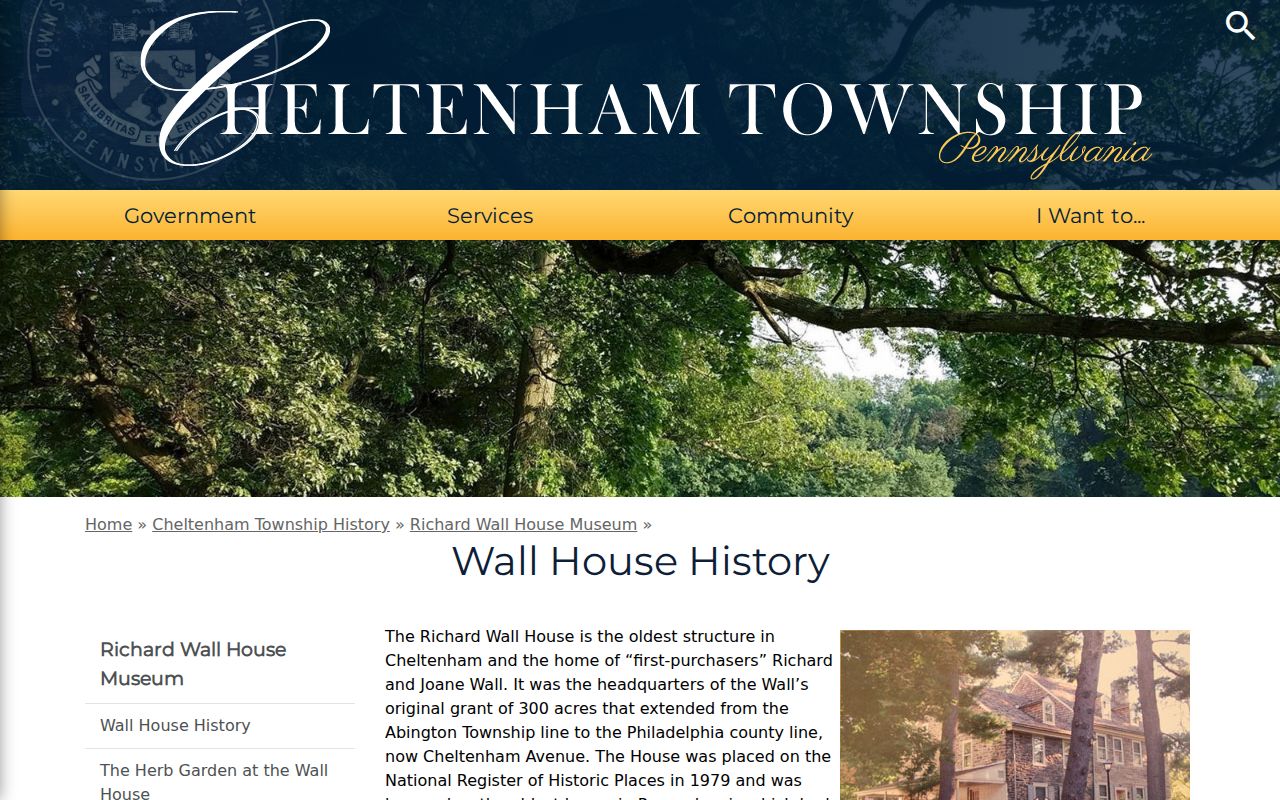
Use the published history as a lead to dated deeds, tax lists, markers, and Historical Commission materials, not as a substitute for the underlying record.
For older county evidence, the Montgomery County Archives record-retrieval page identifies the archival request route and its historical-record context.
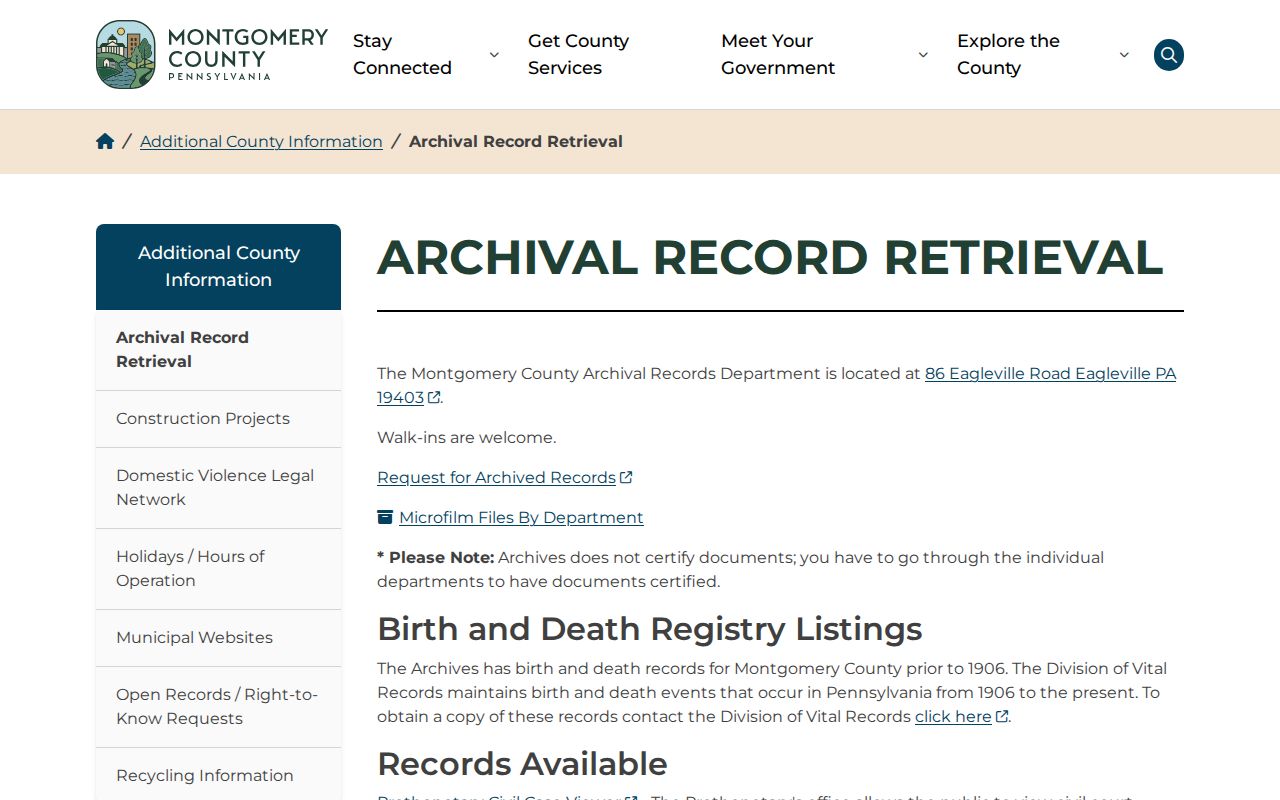
The Archives image reinforces the useful fallback when online indexes stop: ask for a defined record group, date range, and address or community label, then retain the archive's response with the source citation.